
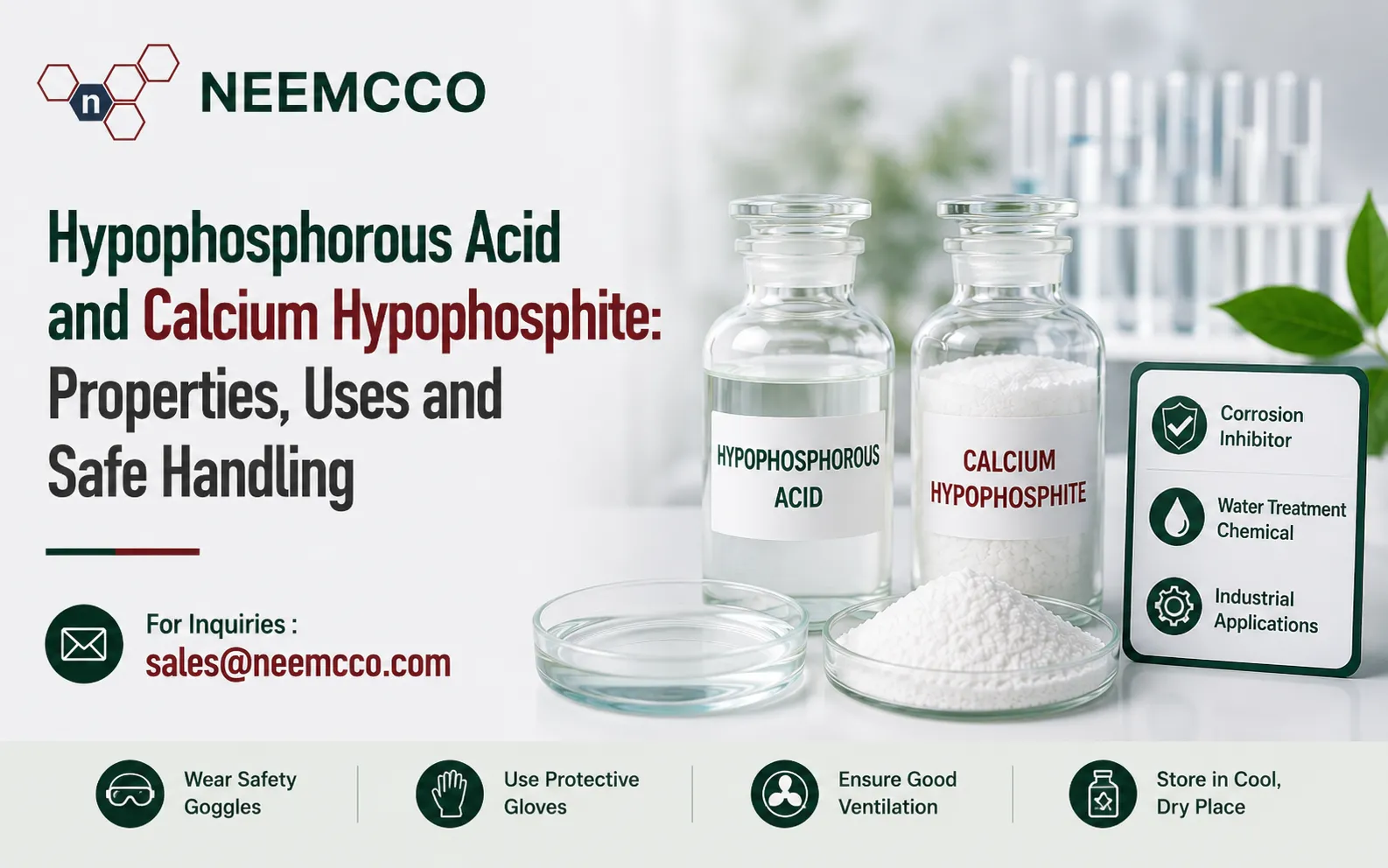
Hypophosphorous Acid and Calcium Hypophosphite are useful phosphorus-based chemicals used in pharmaceutical, polymer, veterinary and specialty chemical industries. They belong to the same chemical family, but they are supplied in different forms and are selected for different production needs.
What is Hypophosphorous Acid?
Hypophosphorous Acid, also called phosphinic acid, has the chemical formula H3PO2 and CAS number 6303-21-5. It is normally supplied as a clear, colourless liquid that dissolves in water. Its most important property is its reducing action. In simple terms, it helps control oxidation during a chemical reaction.
This chemical is used in pharmaceutical synthesis, polymer and resin processing, metal treatment, electroless plating and the production of speciality phosphorus compounds. In resin manufacturing, it can help control colour and reduce yellowing during high-temperature processing. It is also used as a reaction intermediate for making hypophosphite salts and other chemical products.
Neemcco supplies Hypophosphorous Acid in 30%, 50% and 80% concentrations. The correct grade depends on the customer’s process, storage system and final application. A higher concentration is not automatically suitable for every plant. Buyers should discuss concentration, packing and handling requirements before placing an order.
What is Calcium Hypophosphite?
Calcium Hypophosphite is the calcium salt of Hypophosphorous Acid. It is also known as calcium phosphinate. Its chemical formula is Ca(H2PO2)2, and its CAS number is 7789-79-9.
Unlike the acid, which is supplied as a liquid, Calcium Hypophosphite is supplied as a white crystalline powder. It provides calcium and phosphorus, so it is used in pharmaceutical, nutraceutical and veterinary formulations. It is also used as a phosphorus-based, non-halogenated flame-retardant additive in plastics and polymers.
In speciality chemical manufacturing, the material may be used as a reducing agent or as an intermediate for other phosphorus compounds. Neemcco lists Calcium Hypophosphite with purity above 98%, along with information about solubility, pH and impurity limits.
Safe Handling and Storage
Hypophosphorous Acid should be handled by trained workers wearing suitable gloves, safety goggles and protective clothing. The workplace should have good ventilation, especially while transferring the liquid. Containers must be compatible with the product and should remain closed when not in use.
Calcium Hypophosphite is a powder, so workers should avoid creating dust during opening, weighing and mixing. The bags should be stored in a clean, dry area and protected from contamination and moisture. Spilled powder should be collected according to the site’s chemical handling procedure.
Before using either product, read the Safety Data Sheet carefully. The Certificate of Analysis should also be checked for every batch. Important details include concentration, purity, appearance and impurity levels. Proper records support traceability and help manufacturers maintain stable quality from one production batch to the next.
The two products should not be treated as interchangeable. Hypophosphorous Acid is chosen when a liquid reducing agent or reaction intermediate is required. Calcium Hypophosphite is selected when the process needs a solid calcium and phosphorus source or a powder for polymer compounding.